How AI is Changing the Way Patients Find (And Choose) a Dentist
Statistics About AI
In only 3 and a half years, AI has reached into every corner of the business and healthcare landscape, including dentistry. Emerging applications of AI in dentistry now include clinical imaging, insurance verification and patient communication. Beyond operations and treatment, AI is also transforming the way patients find and choose their dental care providers. According to Harvard Business Review, regular users of ChatGPT hit 900 million in 2026, and Google’s Gemini users surpassed 750 million. The trends are increasing year over year, which means that regardless of your patient demographic, AI currently sits as a primary and regularly used resource for patients in your community.
Are Patients Using AI to Find a Dental Practice?
Absolutely. As data continues and user patterns continue to emerge, year over year trends indicate that AI is playing a more significant role in discovery and decision-making processes. Patients use AI to research providers, explore treatment options, and verify family or friend referrals. A recent survey reported these statistics:
- 31% report using AI to research providers
- 26% said AI directly influenced their choice of provider
- 73% of patients reported adopting new search behaviors in the last year
In fact over the past 2 years, AI use case themes are shifting from content creation and education to decision-making and personal support.
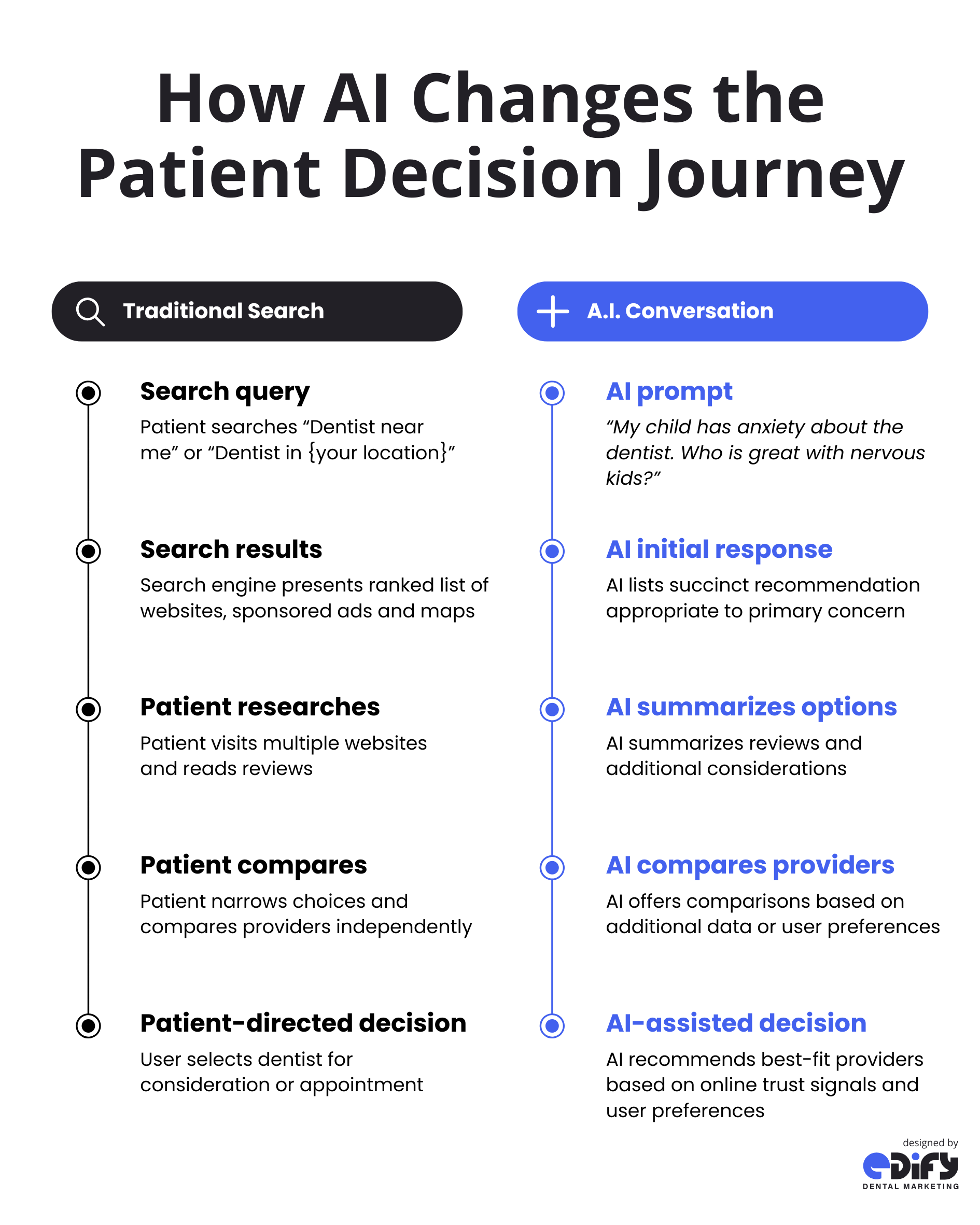
AI is not just another search tool. It’s becoming a decision-making tool. Patients aren’t searching “dentist near me” in ChatGPT. The queries are increasingly sophisticated and conversational. That’s the nature of AI usage, and that’s one of the key differences between answer engines and search engines. AI platforms like ChatGPT, Gemini and Grok are increasingly referred to as “answer engines” because they generate direct responses rather than a list of links. Search engines provide results intended to best match the keywords and phrases entered through queries such as, “teeth whitening specials near me” or “best dentist in Waxahachie”. Answer engines, on the other hand, interpret all those data sources in order to provide solutions directly to the user rather than simply recommended sites for independent research.
AI is not just another search tool. It's becoming a decision-making tool.
To illustrate, a patient is experiencing what they think is a toothache. Prior to the advent of AI, he or she might Google “How to know if a toothache is a cavity”. Then blog posts or healthcare publications show up in their search engine results. After doing some preliminary research and discovering that an exam and filling is the recommended treatment for a cavity, a patient may start a new Google search looking for “dentist near me tooth colored fillings”. A variety of dental offices show up in Maps and search results, then the patient browses websites and chooses to call a dental office based on personal priorities and preferences.
With platforms like ChatGPT, Gemini and Grok, now a patient can start with a highly specific prompt, such as:
“I’ve been having an ache in my lower jaw but not sure if it’s a toothache or something else. How do I know if this is a cavity or not?”
The answer engine then produces a grid of information about jaw-related aches and the common signs of each. Because AI is designed to continue the conversation, the program asks a series of follow-up questions to learn more about the patient’s jaw ache and to help direct the patient to a meaningful solution. Throughout the interaction, AI cites various sources, including dental websites, directories and authoritative healthcare resources, and eventually may offer to recommend local providers. Depending on the platform, AI may ask a question like, “Would you like a list of recommended dentists in your area who treat bruxism?” If the answer is “yes”, the patient then receives the top recommendations from AI based on proximity, service offerings, reviews, online reputation, and other relevant factors. As the conversation progresses, the patient may share more details about scheduling needs, dental insurance or other priorities, and ask for the top 3 recommended offices in their area. Within a matter of minutes, a question about a possible toothache exposes a patient to bruxism, TMJ and the need for a specialist.
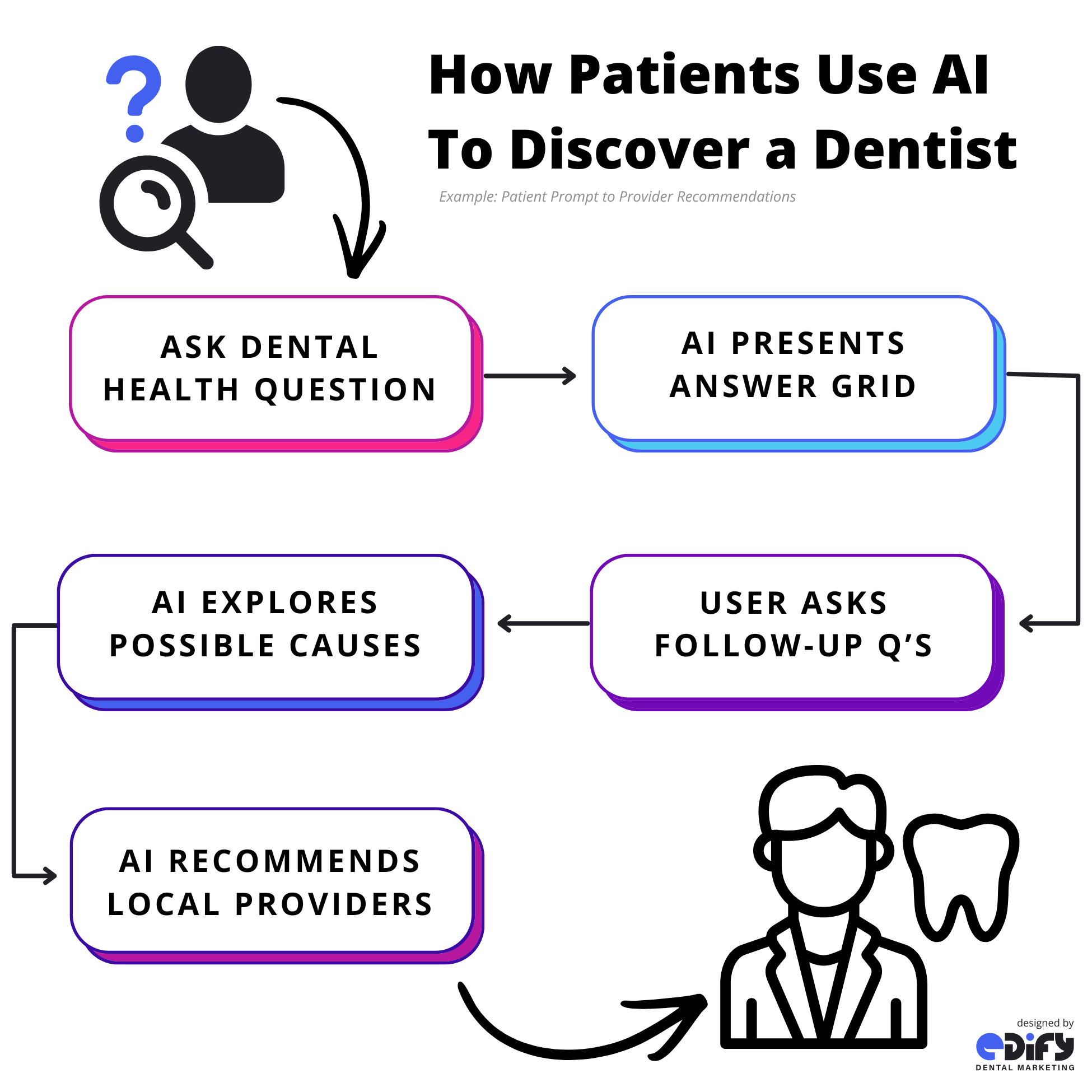
The benefit of AI for dental practices in this type and similar scenarios is that the patient has already moved down the decision-making path and is closer to a conversion point—but only for those practices that make it onto AI’s list of recommendations. Invisibility is the fate of others.
Of course, this is just one illustration of how patients encounter dental practices through AI. But understanding the conversational and solution-focused approach to AI usage helps inform marketing strategies for dentists who recognize the importance of practice visibility as key to marketing success (spoiler alert: visibility is absolutely essential).
3 Ways AI Impacts Practice Visibility and Marketing Metrics
To be clear, AI impacts more than just how patients are finding dentists and choosing providers—AI impacts practice visibility and marketing metrics for dentists. Here’s three key impact points to be aware of:
AI Responds to Highly Specific Queries
The previous example illustrates how AI engages users in highly specific conversations. For practices with limited or generic digital content, you essentially become invisible to AI users when no content match or reference exists. If a potential patient asks Grok:
“I don’t have dental insurance, but need to start taking my kids to the dentist. Can you help me find a family dentist near me who offers payment plans and dentistry for kids?”
Only practices with published digital content specific to all those elements will have any chance at visibility. Your practice may very well check every box for that patient, and your receptionist may have a script to be sure that every new patient phone call includes those talking points. But unfortunately, your practice will be invisible on AI and will likely not get that phone call because the published digital content says you’re not a good match.
AI Sources Data More Broadly Than Search Engines
The sourcing breadth of AI means more data points are synthesized and referenced when presenting answers to users. Activity on social media, review content, responses to online reviews and callouts on various platforms contribute to data density, which is read and favored by AI even more so than traditional search engines.
AI Skews Traffic Metrics
Website and marketing metrics for dental practices have been like a rollercoaster since the introduction of AI. AI hits on websites caused traffic spikes until software updates began accounting for AI hits, which then caused significant drops in reported traffic and showed a level of volatility that wasn’t entirely accurate. The adaptation of analytic tools to AI continues to evolve in order to help marketers and practice owners have a clear understanding of both the amount of traffic and the type of traffic coming to their dental website. Metrics, especially when not clearly defined or interpreted, no longer tell the whole story of how your website and marketing is performing. The best way to get a pulse on the effectiveness of your dental website and marketing is to take a broader look at trends and a deeper look at completed new patient appointments, production rates and patient retention.
Getting Started Optimizing Your Dental Practice’s Digital Presence for AI
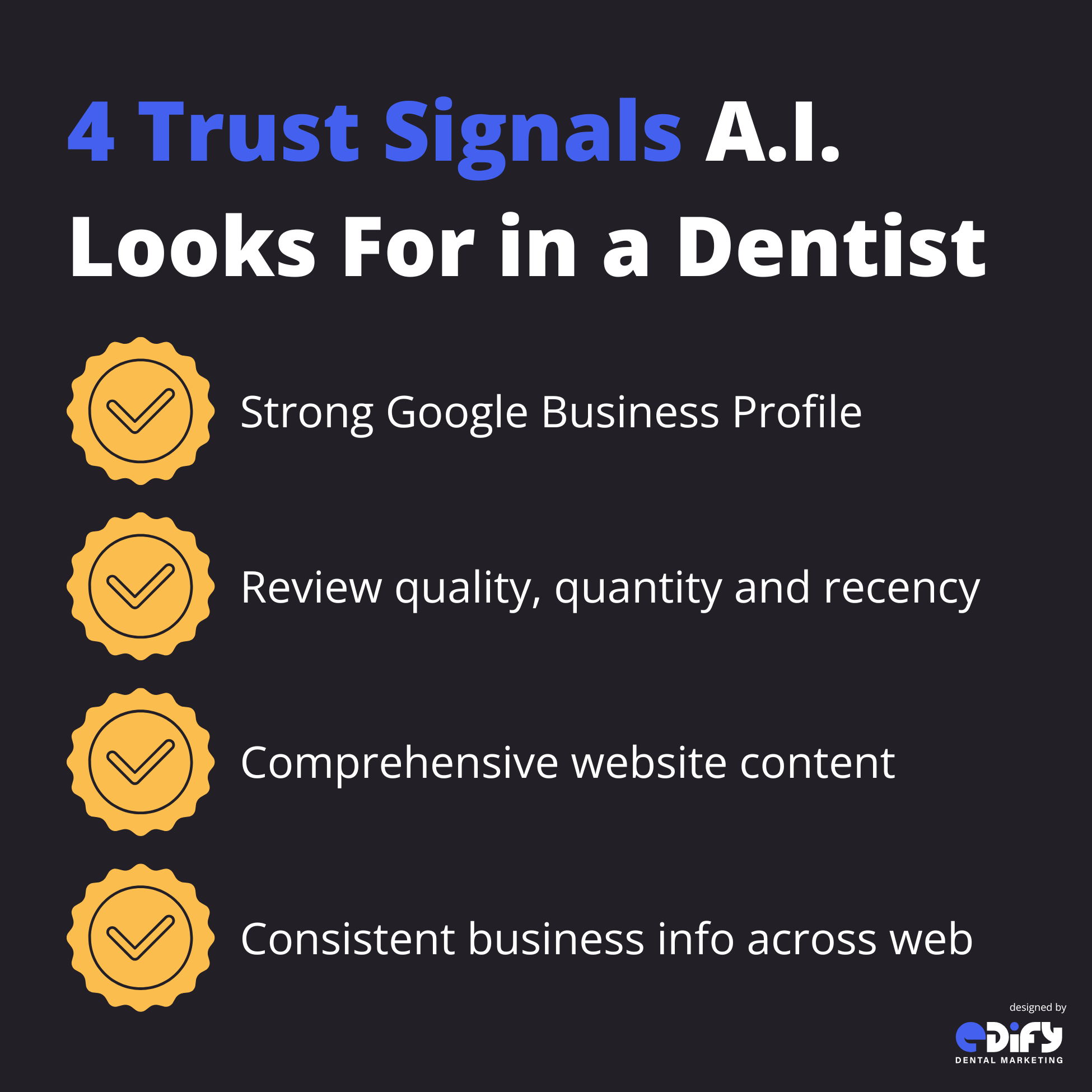
Understanding some of the unique ways that AI is transforming marketing for dentists helps practice owners and stakeholders make informed decisions about dental marketing. As a highly sophisticated tool, AI looks for more than keyword matches—it looks for trust signals. Trust signals are elements of your digital presence that help AI determine which dentists are credible, authoritative and relevant for the given question or conversation. Optimizing your dental practice's digital presence for AI then becomes a strategic and robust effort focused on investing thoughtfully in everything from topical authority to reputation signals and authentic, human-driven content. A challenging undertaking? Yes. A valuable investment? Absolutely.
While every practice’s needs and growth goals are different, here are four ways to optimize your practice’s digital presence for AI and position your dental practice for high visibility and high conversion rates.
Monitor AI platforms and your competition
Think like a potential patient and start some conversations with various AI programs to determine your practice’s AI visibility, strengths and weaknesses. Be careful not to tip your hand to AI though because AI is programmed to pick up on user “cues” and affirm certain behaviors or preferences disclosed by the user.
Focus on establishing an omnichannel presence
An omnichannel presence means showing up everywhere your patients—and AI—might be looking. Create social media accounts on Facebook, Instagram and LinkedIn. Claim and optimize your Google Business Profile and Apple Business Listing. Ask patients to leave reviews on Google, Yelp and Facebook. Submit your practice information to data aggregators and register with online directories. Explore options for publishing evergreen content on external websites. Each of these touchpoints expands your practice’s digital footprint in a way that gets noticed by AI.
Create original content consistently
Once you’ve broadened your practice presence, now it’s time to deepen and enrich it. Develop and publish answer-focused and granular data on your website including FAQs, blog articles, specific insurance information and treatment timelines. Post updates to your social media accounts and Google Business Profile on a weekly basis. Avoid using generic or unedited, AI-generated content. Instead, be personal and speak directly to your patient demographic and community with a brand voice that fits your practice personality and target audience.
Publish specific, conversational content
When publishing content, consider what questions users might be asking AI and then answer those questions in a helpful, structured format. Keep your content well-organized and meaningful to the reader. Take your audience on a journey from question or problem to solutions and specific answers. Avoid simply pushing sales-y content that doesn’t address real concerns or relies too heavily on self-promotion.
Final Thoughts on How AI Impacts Dental Marketing and Patients Choosing a Provider
Even if AI and “answer engine optimization” seems like a different beast entirely from search engines and SEO, they really are two sides of the same coin. Both sources draw from pre-existing content and attempt to read or synthesize data to present relevant information to the user. If you want to optimize your practice’s marketing for AI, do the basics well. Create quality content. Build a 5-star reputation. And provide an opportunity for your patients to do the talking for you. AI optimization will never replace patient-centered care—but it is rapidly reshaping how patients discover practices who provide that level of care. Practices that invest today in digital visibility and credibility will be the ones patients—and AI—recommend tomorrow.
Ready to optimize your dental practice for A.I.?
 855.212.8393
success@edifydental.com
6510 Abrams Rd
Suite 600
Dallas, TX 75231